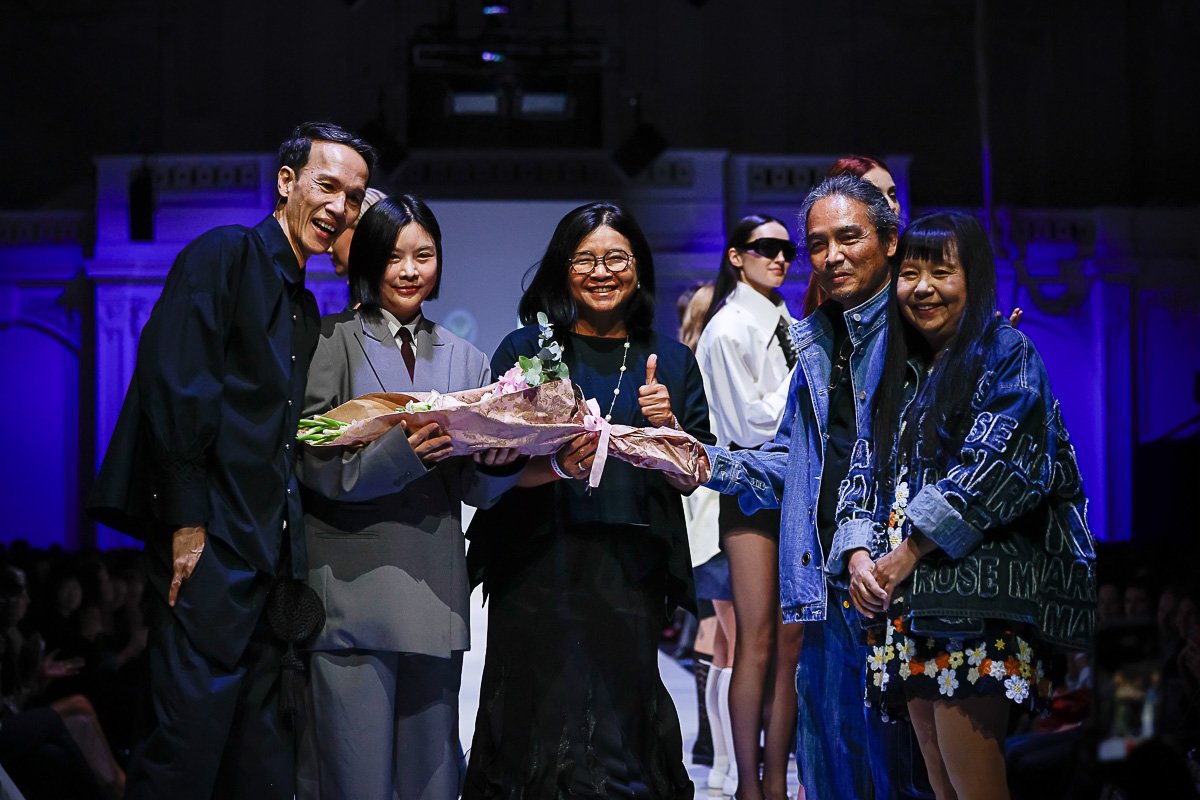
On Thursday evening, the MuseumsQuartier became a meeting point between Vienna and Bangkok. As part of VIENNA FASHION WEEK.26, FRANK WEENEGGSINN, NICHP and ROSE MARS brought three distinct perspectives on contemporary Thai fashion to the runway. Presented together, the collections revealed just how differently tradition, techniques and contemporary design can be translated into fashion.
The Royal Thai Embassy presentation was part of VIENNA FASHION WEEK’s international programme, which this year places a particular focus on creative exchange beyond Austria. Bringing designers from Thailand to Vienna opened a window into a fashion landscape shaped by craftsmanship, experimentation and a strong connection to materials. Rather than presenting one unified vision of Thai fashion, the showcase highlighted three individual identities, each with its own language, references and approach to design.
FRANK WEENEGGSINN: HISTORY IN MOTION
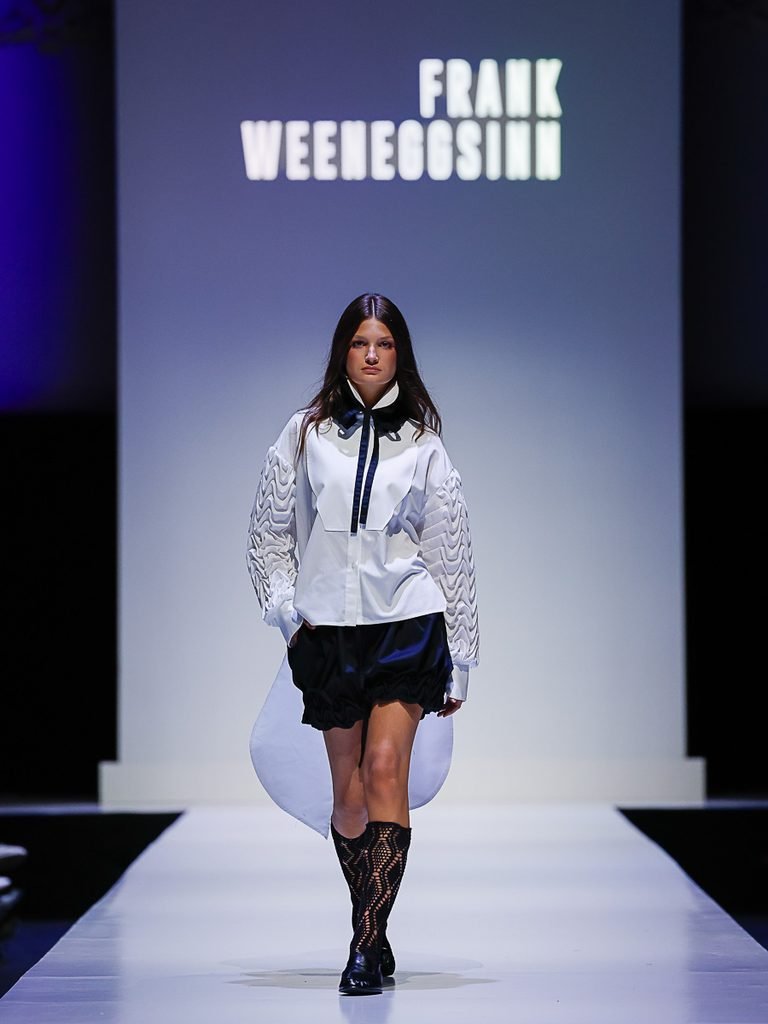
FRANK WEENEGGSINN approached fashion through memory, techniques and historical references. The collection, Nostalgic Spell, translates textile techniques associated with the Victorian era into contemporary silhouettes. Rather than simply reproducing the past, the collection turns historical details into something distinctly modern and wearable.
Plaid, lace and delicate floral elements appeared alongside bow ties, knee-high socks and sparkling strass details. These elements created a visual language that felt romantic and nostalgic while remaining playful and contemporary. Lace was used not simply as decoration, but as part of the texture and character of the garments, adding softness and intricacy to the silhouettes.
The styling further strengthened the dialogue between historical references and modern fashion. Details such as bow ties and knee-high socks evoked another era, while the silhouettes and combinations gave them a fresh context. The collection therefore avoided feeling like a literal interpretation of historical clothing. Instead, it borrowed selected elements from the past and transformed them into a new visual vocabulary.
There was also a sense of playfulness running through the collection. Floral details, lace and sparkling embellishments brought a lighter and more expressive quality to the looks, while plaid and structured elements provided contrast. Romance met structure, softness met tailoring, and nostalgia was placed alongside contemporary styling.
At the heart of the collection was therefore a simple idea: the past does not have to remain in the past. Through contemporary cuts, unexpected combinations and intricate surface details, historical craft becomes part of a new fashion language. Nostalgic Spell showed how references from another time can be reinterpreted rather than simply preserved, allowing familiar techniques to acquire a new identity on the modern runway.
NICHP: WHEN MATERIAL BECOMES FORM
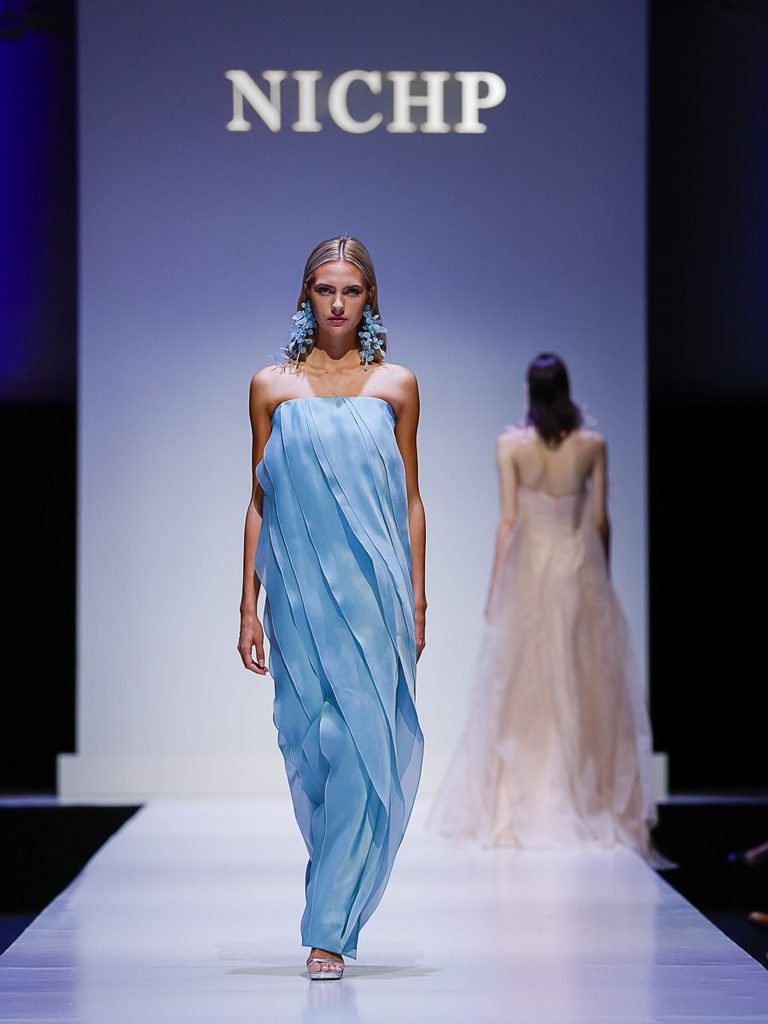
Making its debut at VIENNA FASHION WEEK, Bangkok-based label NICHp brought together modern minimalism, femininity and classic tailoring. In contrast to the nostalgic references of FRANK WEENEGGSINN, NICHp created a more restrained and graphic visual world, allowing the construction and materials of the garments to become the focus.
The collection was built around black and white, complemented by softer shades such as beige and teal. This controlled colour palette created a clean visual language while allowing individual details and silhouettes to stand out. The looks played strongly with proportion: maximalist, sculptural tops were contrasted with shorter, cleaner and more restrained lower parts. The contrast between volume and simplicity gave the collection a distinctive graphic quality.
One of the most striking elements was the relationship between material and design. Plastic was transformed into accessories and decorative elements, demonstrating how an unexpected material can become part of a carefully considered fashion object. Rather than being treated simply as something disposable, the material was given a new context through design and craftsmanship.
This approach reflects a wider interest in transforming materials and reconsidering their possibilities. Recycled plastic elements can become handmade fashion details, shifting the material from something associated with waste towards something expressive and visually significant.
The collection also demonstrated the power of restraint. With its monochromatic foundation and clear silhouettes, NICHp allowed shape, proportion and material to communicate without relying on excessive decoration. The dramatic tops created visual impact, while the simpler lower silhouettes balanced the overall looks.
The result was fashion reduced to its essential components: material, shape, proportion and detail. Material becomes form could almost serve as the visual principle of the collection. NICHp showed that minimalism does not necessarily mean simplicity. Instead, a limited palette and carefully controlled silhouettes can create space for construction, texture and material experimentation to become the main story.
ROSE MARS: DENIM AS A CANVAS
ROSE MARS closed the Thai showcase with a completely different energy. For the Bangkok-based label, denim is not simply a familiar wardrobe staple. It becomes a canvas for experimentation, reconstruction and craftsmanship.
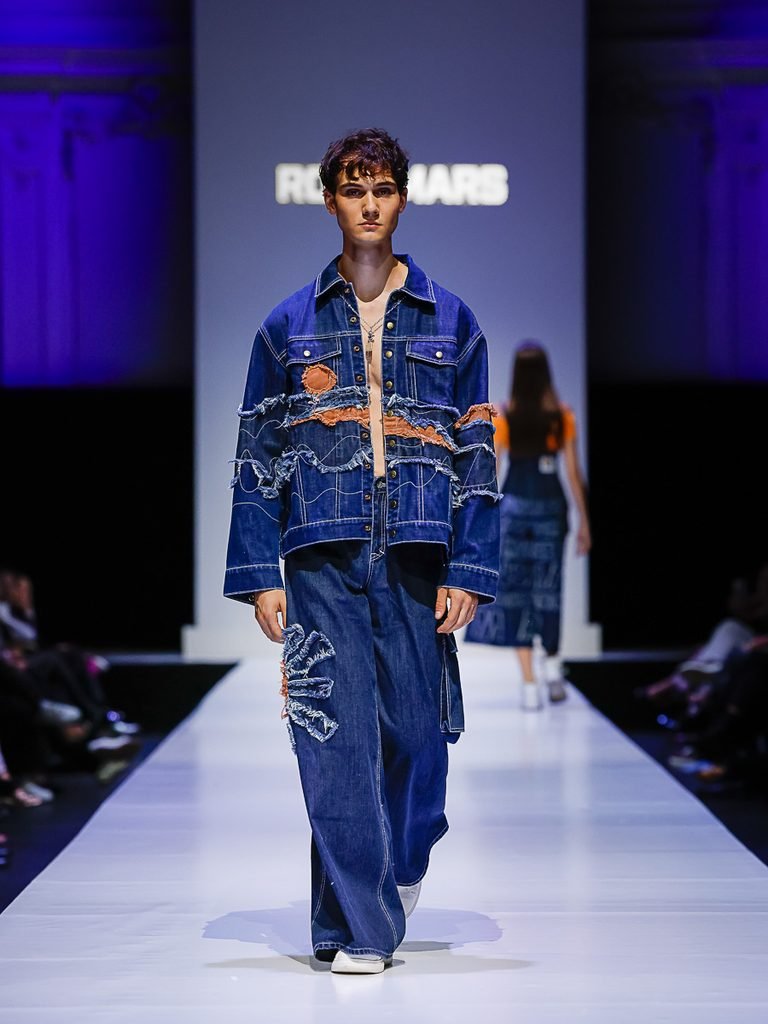
The collection explored denim through embroidery, layered fabrics, cut-outs and contrasting textures. Rather than keeping denim in its traditional form, ROSE MARS reconstructed and reimagined the material, creating silhouettes that moved between streetwear and more expressive, sculptural fashion.
Embroidery introduced craftsmanship and intricate detail, while fabric overlays added depth and movement to the garments. Cut-out elements interrupted the familiar structure of denim and created unexpected openings and proportions. Together, these techniques transformed a recognisable everyday material into something more experimental.
There was a strong sense of construction throughout the collection. Instead of hiding the process behind the finished garment, ROSE MARS allowed the material and its transformation to remain visible. Layers, seams, textures and embroidery became part of the visual identity of the looks.
This approach also connects closely to the idea of sustainability. Denim is a durable material that can acquire more character through wear, making it particularly suitable for reinterpretation and upcycling. An existing pair of jeans can become something completely different, while leftover fabric can be transformed into new garments, accessories or details.
For ROSE MARS, this creates a different relationship with fashion. Instead of seeing an old garment as something that has reached the end of its life, it can become the starting point for another design. The collection therefore combined the recognisable attitude of denim with a more experimental approach to construction and material use.
THREE LABELS, THREE LANGUAGES
Together, FRANK WEENEGGSINN, NICHp and ROSE MARS demonstrated the breadth of contemporary Thai fashion.
What connected the three collections was not a single aesthetic, but an approach to fashion rooted in craftsmanship, material exploration and reinterpretation. Each designer began from a different point. FRANK WEENEGGSINN looked towards historical references and transformed them through contemporary silhouettes. NICHp focused on the relationship between material, proportion and form. ROSE MARS took denim, one of the most familiar materials in contemporary fashion, and transformed it through embroidery, layering and reconstruction.
Tradition was not presented as something fixed. Materials were questioned, reconstructed and given new meaning. Historical techniques became contemporary details, plastic became part of a fashion object, and denim became a surface for experimentation. That made the Thai showcase more than an international guest appearance. It became a conversation between different ways of thinking about fashion: between history and innovation, minimalism and expression, craftsmanship and experimentation. The three collections also demonstrated how individual identity can remain at the centre of an international fashion exchange. Although the designers shared one runway and one cultural programme, their approaches remained clearly distinct. The result was not a single definition of Thai fashion, but a collection of perspectives showing the variety within it.
As VIENNA FASHION WEEK continues to expand its international perspective, the THAIdentity showcase offered a glimpse of how fashion can create connections across cultures without losing the individual identity of the designers behind it. On one Vienna runway, three Thai labels presented three different ways of looking at fashion, and showed that contemporary design can emerge from history, materials, craftsmanship and the constant desire to transform what already exists.
